
 The Audible Recitation of the Secret Priestly Prayers of the Divine Liturgy from an Empirical Perspective
Pan. Papadimitriou, PhD
From the 2nd Greek edition (7/6/2026), 24/8/2026
[at the end the article is given in pdf]
“having shut thy door, pray to thy Father who is in secret”, Mat. 6:5–6
“while the Secret Prayer is being performed” (St. Gregory of Nyssa, 4th c.)
“the first [Prayer] silently/secretly”, 19th Canon, The Council of Laodicea (364 A.D.)
A characteristic feature of the Orthodox is their adherence to Tradition. The observance of Holy Tradition is an Apostolic command: “Stand fast, and hold the traditions” (2 Thess. 2:15). “Let all things be done decently and in order” (1 Cor. 14:40). In ministry within the Orthodox Church, each person does not simply act according to his own will; otherwise, in practice, he adopts a Protestant mentality. The Church is “following the Holy Fathers,” not following the personal opinions of each individual.
Why must the Tradition of the Church be observed? Holy Tradition is the secure path of the Church, the path of the Holy Fathers, the secure path of divine worship, prayer, repentance, purification, illumination, and deification.
As we saw in a previous article, the Tradition of the Divine Liturgy is as follows: the Deacon proclaims aloud (eis epēkoon) the common Prayers by way of exhortation, addressing the Priest and the faithful; they, in response, pray secretly (inwardly, mentally) and individually—the Priest with his own Prayers, and the faithful with the silent Kyrie eleison (“Lord, have mercy”) or with their own prayers. The Chanter responds aloud as the “guide” of the faithful in their prayerful responses to the Deacon’s common Prayer.
By the grace of God, all these prayers together ascend to God, not as separate prayers, but as one common and powerful Prayer, as one common force. This means that even the smallest prayer of a spiritually negligent member of the faithful in church acquires greater boldness before God than when he prays alone at home—though home prayer must by no means be neglected—because he participates in the common Prayer of the Church.
Let us not neglect prayer at home. Prayer at home strengthens our prayer in church, and prayer in church, in turn, strengthens our prayer at home. When repentance, forgiveness, guilelessness, love, and humility are also present, then our prayer acquires even greater power—always by the grace of God.
According to Ioannis Fountoulis, during his lifetime, the overwhelmingly predominant Tradition was the ancient Tradition of the Prayers being recited secretly, silently, inwardly (not the modern innovation of their audible recitation):1
a) “A tradition extending over many centuries has, however, been formed concerning the secret reading of the Prayers, and this today is the generally prevailing order throughout the entire Orthodox Church.”
b) “Quite early there prevailed the practice that the prayers of the Divine Liturgy be said secretly (μυστικῶς). Usually the priest said them at the time when the deacon was saying the synapte, in any case before the ekphonesis.”
c) “Secretly, as is well known, all the Prayers of the Divine Liturgy are said today, except for the Prayer Behind the Ambo [at the end].”
d) “Secretly are said the Prayers which are addressed to God.” [Yet all Prayers are addressed to God (!), not to men, but for men, for the world, etc.].
The audible recitation of the Prayers in the Divine Liturgy was promoted in Greece mainly during approximately the last eighty years, and with particular intensity, publicity, and widespread diffusion after the repose of the late Archbishop Seraphim of Athens (+1998), by theologians, liturgists, and clergy (including Bishops) who were influenced by the preparatory developments leading up to the Second Vatican Council (1962–1965),2 and who in turn influenced numerous clergy and laypeople, who then influenced many others, down to the present day.
Unfortunately, in our time, many people, at every opportunity, whether appropriate or inappropriate, advocate the innovative practice of Priests reciting their Prayers aloud during the Divine Liturgy.
They say: The Priest should pray aloud, so that the faithful may hear him.
In previous articles, we have addressed this question with numerous references to Holy Tradition, the manuscripts, the Saints, and the Holy Councils. Here, we shall attempt to respond more briefly, primarily from an empirical point of view.
A. Response from the Perspective of Holy Tradition:
There is no evidence in the Holy Tradition of the Church, with regard to the Divine Liturgy, that the Priest recited the Prayers audibly for the congregation to hear. On the contrary, their secret recitation is attested, either explicitly or implicitly.3 Indeed, even the Hieratikon published by the Apostoliki Diakonia prior to 2002/2004 explicitly prescribed that the Priestly Prayers of the Divine Liturgy be recited secretly.
The Holy Synod of the Church of Greece, moreover, issued not one but three (3) Synodal Encyclicals addressed to those innovators who persisted in disobedience: Prot. No. 499 / 16 February 1951, Prot. No. 1353 / 9 June 1956, and Prot. No. 1137 / 13 March 1974—to ears unwilling either to hear or to understand.4
The faithful heard the common Prayers proclaimed by the Deacon, just as the Priests heard them; and, in response, both the Priests and the people5 prayed secretly, inwardly. Only the Chanter responded aloud, serving, as it were, as a “guide” for the faithful in their prayerful responses to the Deacon’s Prayer.
Of the Priestly Prayers, the faithful heard only the “later” Prayer behind the Ambo at the conclusion of the Liturgy. 6 This is also why it was recited aloud in the middle of the church—so that the faithful could hear it, in an age before microphones and loudspeakers—with the Priest always facing east, standing before the ambo, which at that time was located in the centre of the church (or “behind the ambo,” opisthambonos, if the ambo is viewed from the direction of the sanctuary).
Likewise, the Priests do not hear the secret prayers of the faithful, nor those of the monks in monasteries; nor does any Orthodox Christian pray in church audibly for the person standing beside him to hear. For this reason, when the Deacon addresses the assembly, he does not say: “In peace, pray to the Lord, Father! And you, faithful people, listen to the Father as he prays aloud!” Neither does he say: “In peace, you faithful, pray to the Lord!”
What, then, does he proclaim? He proclaims: “In peace, let us pray to the Lord!”
To whom does the Deacon address the words “let us pray”? Naturally, to the Priest and to the faithful people. 7, 8, 9
B. Response from the Perspective of the Faithful (and of Monastics in Monasteries)
The innovators argue that the faithful—and, by extension, the monks in monasteries—should hear the secret Prayers of the Priest.
Even if we set aside the innovative character of this position, they do not explain what, precisely, the faithful (and the monks) are expected to do while the Priest is reading the secret Priestly Prayer aloud. Are they to listen actively (that is, to reflect upon it intellectually—or how exactly is “actively” to be defined?), passively, or to follow the Priestly Prayers by reading them from the latest modernist editions of the “Hieratikon for the Faithful”? If their attention wanders for a moment, and they fail to hear or read one, two, or ten sentences of the Priest’s Prayer—or even the entire Prayer—what then becomes of their “participation”?
Can the faithful truly pray while listening to the secret Prayers of the Priest, or are the faithful transformed into reflective listeners, then perhaps merely hearers, and eventually into indifferent spectators? 10
Prayer is not the hearing, comprehension, or interpretation of Prayers, nor is it a form of theatrical observation. The liturgical Holy Tradition of the Church does not require the faithful to be present as hearers or interpreters of the Priestly Prayers, nor as spectators of the Priests, but rather to participate prayerfully in the common Prayer of the Church. What is required is that the whole Church pray together, heeding and responding to the common Prayers proclaimed by the Deacon, while each person prays secretly and inwardly (“the Prayers of the multitude” and “the Prayers of the Priests,” as St John Chrysostom says; see also St Porphyrios). 11
What power this common Prayer possesses! The secret Prayers of the Priest and of the faithful, are neither competing nor disconnected prayers, but one common ecclesial Prayer which, by the grace of God, ascends to God.
When, however, the listening—the recitation—becomes continuous, theologically and conceptually dense, and demanding of sustained attention, it hinders the inward prayer of the faithful and turns the believer into a listening observer. Yet the Deacon said, “Let us pray to the Lord,” not “Pray, Father!” The faithful, too, must pray secretly and inwardly; and when the Priest prays aloud, he makes that inward prayer more difficult, whether knowingly or unknowingly—especially when microphones are used.
It is for this reason that the great practitioner of prayer, the dispassionate and watchful Saint of our own times, St Joseph the Hesychast, called out to the hieromonk: “Do not shout, Father; say them quietly, just as it is written in the Hieratikon, that they are to be said secretly.” 12, 13
The same difficulty caused by a Priest praying aloud affects not only the faithful, but also concelebrating Presbyters who wish to pray together. In earlier practice, the Tradition of Priestly Concelebration was that each Priest (and each Bishop) would recite the secret Priestly Prayers privately, 14 just as each member of the faithful (and each monastic) prays privately, in accordance with the commandment of the Lord: “shut thy door and pray to thy Father.”
Yet, although all pray individually within the Church—Priests and faithful alike—responding to the common Prayers proclaimed by the Deacon, nevertheless one Prayer, one spiritual force, ascends to God (ftn. 11)!
“Let the whole body of the Church, with one accord, offer up the supplication with one voice, the Priests being present and presenting the prayers of the common multitude,” Chrysostom [PG 56, 182]; cf. [PG 48, 725]. That is: “the supplication is offered by the multitude of the faithful, by the body of the Church, with one soul, in the presence of the Priests, who offer to God the prayers of the congregation.” 15 This also explains the plural forms found in the Priestly Prayers, which the innovators misinterpret. The plural signifies that the Priest also presents the prayers of the faithful; it does not signify that the secret Priestly Prayers must be made audible to the faithful.16
Even if the faithful person wishes, or attempts, to pray while listening to the Priest’s secret Prayer (where it is recited aloud), his mind is drawn away from his own prayer in order to follow and understand what he is hearing, insofar as he is able to do so and insofar as his theological and spiritual formation permits. Even if the faithful person holds before him the text of the secret Priestly Prayer, or reads it in a Modern Greek translation, 17 he may still fall into the same—and even greater—distractions: he tries to read, to listen, not to lose his place, to study, to reflect, to comprehend intellectually the theological meanings, to notice any possible errors on the part of the Priest or in the text itself, or to assess whether the Priest is reading correctly and conveying the meaning properly, while at the same time attempting to … pray. If he is also reading from a mobile phone, the situation is even worse. This, however, is not Prayer, but at best auditory or intellectual following.
In substance, the innovators bind heavy burdens and lay them on men’s shoulders.
What is Prayer? “Prayer is the ascent of the mind to God, or the asking of fitting things from God,” St John of Damascus [PG 94, 1089C–D, ch. 64]. 18 In the Divine Liturgy, such asking consists in the personal prayerful response directed to God in response to the common Prayer proclaimed by the Deacon (or in each person’s own private petitions); it does not consist in listening to the Priest’s Prayer. Likewise, the “ascent of the mind to God” 19 is the mind’s speaking to God, for “Prayer is the mind’s speaking to God” (Evagrius/Nilus) [PG 79, 1168C, ch. 3]. There is, of course, also an ascent of the mind to God without verbal speaking. 20
If, when speaking to a Prime Minister, a ruler, or someone whom we hold in high esteem, we naturally adopt an appropriate disposition, how much more should this be so in our speaking—our prayer—to God.
Metropolitan Athanasios of Limassol says: “In essence, the Saints do not think; they pray.21 That is, discursive thought is set aside, and prayer remains—prayer which is a question addressed to God and an answer received from God. Such are perfect humans beings, those who are in Christ.”22
The faithful person—and especially, as is often the case, the young person—does himself a disservice when he uses a modernist “Hieratikon for the faithful” during the Divine Liturgy. He remains present throughout the service, yet in practice, because of the distractions involved, it becomes difficult for him to pray truly.
By the grace of God, you will understand the Divine Liturgy more deeply and more correctly by participating in it through your secret prayer than by reading about it—although reading is, of course, also very beneficial, provided that the book contains no errors, but this should be done outside the service and outside the church. “Prayer enlightens the human person. If a person prays, then he will receive assurance from God.” 23 It is also necessary, however, to cultivate virtue, so that prayer may have power [PG 61, 398].
Of course, the Priestly exclamations, blessings, the exhortations that properly belong to the Tradition of the Church—not the modernist “all together”—the readings, the troparia, and so forth, which the Church’s Tradition has wisely incorporated into the order of the Divine Liturgy, and which serve as doxology and catechesis while at the same time, by the grace of God, spiritually strengthening the faithful for more attentive prayer, these are traditionally proclaimed aloud, not secretly.
C. Response from the Perspective of the Priests
The Priest’s audible prayer during the Divine Liturgy is not only contrary to Tradition, 24 and contrary to the canonical order,25 nor does it merely distract the praying faithful from their secret (inward) prayer; it also distracts the Priest himself. The “[audible] recitation of the Prayers for the congregation to hear requires rhetorical projection, modulation of the voice, and often a pompous style and other ‘dramatic’ abilities—elements that stand in sharp contrast to the solemn and compunctious atmosphere required for the celebration of the Mysteries of the Church.” 26
In this respect, the audible recitation of the secret Priestly Prayers may transform Prayer into a concern with being heard, a rhetorical performance, or a liturgical presentation. The Priest runs the risk of ceasing to be a praying celebrant and becoming instead a reader.
As a praying celebrant, however, he approaches “the throne of the grace of God with boldness, with a true heart, in full assurance of faith, speaking to God and conversing alone with Him” [PG 98, 429A].27 We have already discussed Priestly Concelebration in §B.
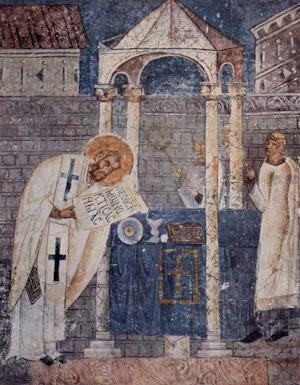
A characteristic rubric (instruction) found in the Euchologia states that the Priest prays while bowed,28 or, more specifically, that “the Priest, inclining himself, prays,” naturally in secret.29 This posture is, moreover, also depicted in iconography. This bowed posture of the praying Priest, as a bodily expression of restraint and reverence, is not suited to the public delivery of speech before an audience, but rather to secret Prayer addressed to God.
This also accords with the patristic interpretation of the Divine Liturgy, and especially of the Holy Anaphora, according to which the Priest “alone to the Alone, he speaks mysteries to God, uttering them in mystery [secretly]” 30 and is “conversing alone with Him.” 31
Figure 1. St Basil the Great praying during the Holy Anaphora (wikipedia).
Thus, the Priest who recites the secret Priestly Prayers of the Divine Liturgy aloud for the express purpose of making them heard by the people does an injustice first of all to himself; he also does an injustice to the faithful, depriving them of true Prayer and making them, willingly or unwillingly, hearers of his secret Prayers—something that would rightly be regarded as disorderly if the faithful or monastics themselves were to do the same by loudly voicing their own secret prayers. Most importantly, however, he does an injustice to the whole Church by diminishing the power of her Prayer. The weakening of the Church’s Prayer may be observed on the personal, ecclesiastical, social, national, and global levels.
At the same time, the audible recitation of the Priestly Prayers of the Divine Liturgy may conceal a form of clericalism. Clericalism does not consist in the secret Prayer of the Priests—the people also pray secretly—but, on the contrary, in their deliberate, often affected, and contrary-to-Tradition audible prayer, when it is performed for the purpose of drawing the congregation’s attention to the celebrant, with the result that the faithful are hindered from praying truly.
To God be the glory for all things.
Footnotes
1 Ioannis M. Fountoulis, Answers to Liturgical Questions, vol. V (2003), nos. 551–553, p. 201; vol. II (1994), no. 235, p. 229; vol. V (2003), nos. 551–553, p. 192; vol. V (2003), no. 558, p. 222.
2 The Second Vatican Council took place between 1962 and 1965. It was, however, based upon the corresponding publications and movements of liturgists that had developed over many years beforehand within the Western-inspired so-called liturgical renewal. It was upon these publications of Western liturgists that Trembelas relied—and by which he was influenced—when he wrote, on p. 61 of his book The Roman Liturgical Movement and the Practice of the East (Athens, 1949):
“For the immediate and active participation of the people in the celebration of the Mysteries, and especially of the Divine Eucharist, and for the restoration of the unity (sic) between the altar and the people, the Roman Catholic liturgical movement advocated, as we have said, that the celebrant should turn toward the congregation during the Anaphora and should read the prayers of the Divine Liturgy in a voice audible to the people.”
The Second Vatican Council was cautious and highly diplomatic on the question of the Prayers—in order to avoid reactions from its own “traditionalists”—and simply condensed all the innovations that had appeared in the West up to that time into the diplomatic expression “active participation” of the people, leaving its “interpretation” to a later stage. Those who came afterwards “interpreted” “active participation” in the same manner as those who had interpreted it before the Second Vatican Council (cf. Trembelas), namely, as requiring the Prayers to be recited aloud. The same term and the same interpretation are also given by our own contemporary so-called liturgical reformers.
More precisely, the Second Vatican Council states verbatim in Sacrosanctum Concilium (4 December 1963), under the heading “II. The Promotion of Liturgical Instruction and Active Participation”: “all the faithful should be led to that fully conscious, and active participation in liturgical celebrations.”
The Western-inspired liturgical mentality, and our own so-called liturgical reformers who follow it, understand the “active participation” of the people in the Liturgy as an auditory, intellectual, and theatrical participation. Hence the audible prayers; hence also the occasional anti-traditional celebration, even within Orthodoxy, of the Divine Liturgy, Memorial services, Holy Unction, the Blessing of Waters, and other services facing westward—that is, with the Priest turned not eastward in prayer, but toward the people; hence also the practice of “everyone together,” and so forth.
Orthodox “active participation,” however, is pre-eminently “participation in prayer.” And prayer is secret, according to the word of the Lord (Matt. 6:5–6).
3 Pan. Papadimitriou, While the Deacon Recites the Prayer, the Priest Prays the Prayer, 30 October 2022.
4 The fact that repeated and stringent Synodal interventions were deemed necessary indicates that the innovative practice was not an isolated or accidental phenomenon, but rather a persistent and organized liturgical deviation.
5 “And let all the faithful pray for them secretly (in their minds, inwardly), saying: Lord, have mercy” [PG 1, 1076–1077]. The Holy Apostles: “while all the people stand and pray quietly” [PG 1, 737]. St Clement: “Let us therefore, having gathered together in concord in one place, cry out earnestly to Him in our conscience, as though from one mouth, that we may become partakers of His great and glorious promises” [PG 1, 277]. For further discussion, see our article on Canon XIX of the Council of Laodicea, especially notes 11 and 15, concerning prayer kata dianoian (“in the mind”, secretly).
6 This Prayer was added to the Liturgy on account of certain inquisitive persons who active contended against not knowing what was taking place [St Germanos, Archbishop of Constantinople (640–740), PG 98, 452C], a type of persons that has never entirely disappeared from the life of the Church throughout the centuries. See also Presbyter G. Diamantopoulos, The Theological Basis for the Concealment of What Is Performed in the Sanctuary according to St Niketas Stethatos, paper presented at the conference of the Estia of Patristic Studies, In the Aftermath of Liturgical Renewal: Disturbances in Divine Worship, 11 June 2023.
7 Pan. Papadimitriou, “Let Us Pray to the Lord”: Neither “Pray Thou, Father” nor “Pray Ye, Faithful” (Secret Prayers), [PDF], translated from the 3rd Greek edition, 15/5/2026.
8 St John Chrysostom: “For the expression ‘Let us pray’ is addressed not only to the Priests, but also to those who constitute the [faithful] people” [PG 61, 399].
9 “The expression ‘let us pray,’ just like ‘let us stand aright,’ which we hear in the Church, is addressed not only to the Priests, but also to the congregation, the people,” Panagiotis G. Stamou, John Chrysostom: Prayer — The All-Powerful Weapon of the Faithful, Athens 1988, p. 34.
10 An anonymous Priest wrote in a comment on a post on the Anastasios blog: “Whether the [aloud secret Priestly] Prayers help toward an understanding of worship and the participation of the people is clearly shown by the manner in which Christians participate in the Mysteries of Baptism and Marriage, and in funerals, where they hear everything proclaimed aloud. No compunction, no sense of the sacred space.” (accessed 27 May 2026).
11 See Sections §B and §C of the article: Let Us Pray to the Lord: Neither “Pray, Father” nor “You, the Faithful, Pray”, 3rd ed., 15 May 2026.
12 Elder Ephraim of Philotheou, My Elder Joseph the Hesychast and Cave-Dweller (1897–1959), Monastery of St Anthony, Arizona, USA, 9th ed., 2019, p. 160.
13 Pan. Papadimitriou, Contemporary (Saintly) Elders and the Secret Prayers, 8 February 2022; Orthodoxos Typos, 13–27 January 2023, nos. 2431–2433.
14 Pan. Papadimitriou, Priestly Concelebration — A Comparison of Rubrics, Hieratika, and Commentary, 21 December 2022.
15 Panagiotis G. Stamou, John Chrysostom: Prayer — The All-Powerful Weapon of the Faithful, Athens, 1988, p. 31.
16 In other words, according to the innovators’ interpretation, if the faithful pray, “Lord Jesus Christ, have mercy on the Priest,” or “Lord Jesus Christ, have mercy on us,” must these prayers also be made audible to the Priest and to the faithful standing nearby simply because they are expressed in the plural? Or, in the absence of a microphone for the faithful, should they approach the Priest and whisper into his ear that they are now praying for him?
17 The question of rendering the texts into Modern Greek is a separate matter. Even the [Greek] New Testament [in Greece] has not been translated in a single universally accepted form, and there are numerous Modern Greek versions of it—one by Zoe, another by Soter, another by Stavros, another by the Apostoliki Diakonia, and so forth. If one turns to published global English translations and paraphrases—now approaching some 900 in number—there is, even in English, still no single official Orthodox translation.
18 See also: “Prayer is the ascent of the mind to God” (Evagrius/Nilus), [PG 79, 1173, ch. 35].
19 “For the mind is the eye and the purest part of the soul” [PG 95, 144B]. “for just as the eye is to the body, so the mind is to the soul”, [PG 94, 924B].
20 Metropolitan Hierotheos of Nafpaktos and Agios Vlasios, Empirical Dogmatics of the Orthodox Catholic Church, according to the Oral Teachings of Fr John Romanides, vol. I, 2nd ed., 2011, Holy Monastery of the Nativity of the Theotokos, p. 109.
21 “Pray without ceasing. In everything give thanks: for this is the will of God in Christ Jesus concerning you” (1 Thess. 5:17–18). Pray without ceasing, especially during the Church services.
22 Homily on Prayer, 52:38 (First Series—lectures at the University of Cyprus, Nicosia).
23 Homily on Prayer, 52:29 (First Series—lectures at the University of Cyprus, Nicosia).
24 Ioannis Fountoulis: “A tradition regarding the secret recitation of the Prayers has, however, been established for centuries, and today this is the generally prevailing order throughout the entire Orthodox Church.”
25 Pan. Papadimitriou, Canon XIX of the Council of Laodicea (364) and the Recitation of the Liturgical Prayers, 3 April 2022.
26 Protopresbyter Alexandros K. Karapanagopoulos, The Divine Liturgy (Introduction – Text – Interpretation), Athens, 1975, p. 12.
27 Pan. Papadimitriou, The invisible of the Altar (hidden Sanctuary) …, chs. 53, 65, p. 242.
28 In earlier times, the people too bowed deeply at the reading of the Gospel and at the “Your own of Your own” (Ta Sa ek ton Son).
29 Pan. Papadimitriou, While the Deacon Recites the Prayer, the Priest Prays the Prayer, 30 October 2022.
30 [PG 98, 429A]. The invisible of the Altar (hidden Sanctuary) …, chs 53, 65, p. 242.
31 In earlier times, the curtains of the sacred Ciborium over the Holy Altar were closed, with the Priest praying within during the Holy Anaphora. See The invisible of the Altar (hidden Sanctuary) …, chs. 11.2, p. 117.
32 analogion.gr/typikon/liturgy-articles.
33 independent.academia.edu/ΠΔΠ/Liturgical.
The article in pdf: Academia, Ἀναλόγιον


